Discover our secret ingredient and bring #gustoLiguori pasta to the table.
Discover our secret ingredient and bring #gustoLiguori pasta to the table.


Discover our secret ingredient and bring #gustoLiguori pasta to the table.
Discover our secret ingredient and bring #gustoLiguori pasta to the table.

Slow drying at low temperatures is the distinctive phase of the Liguori Method. This phase is the most delicate of the entire process and allows the organoleptic properties of the prized 100% Italian raw material to be preserved, guaranteeing a pasta with a unique taste and colour and rigorously al dente. Slow drying at low temperatures guarantees a tenacious pasta, because it preserves the structure of the proteins, preventing denaturation.

Short Pasta
Long Pasta
with temperatures never exceeding 69° C
Slow drying at low temperatures represents an ancient heritage that we have preserved over time. Our know-how has been handed down from generation to generation and after more than two centuries it still represents the vital core of our product.
Besides being the outstanding phase of the Liguori Method, this is the most delicate of the entire process and allows the organoleptic properties of the prized 100% Italian raw material to be preserved, guaranteeing a tenacious pasta with a unique taste and colour.
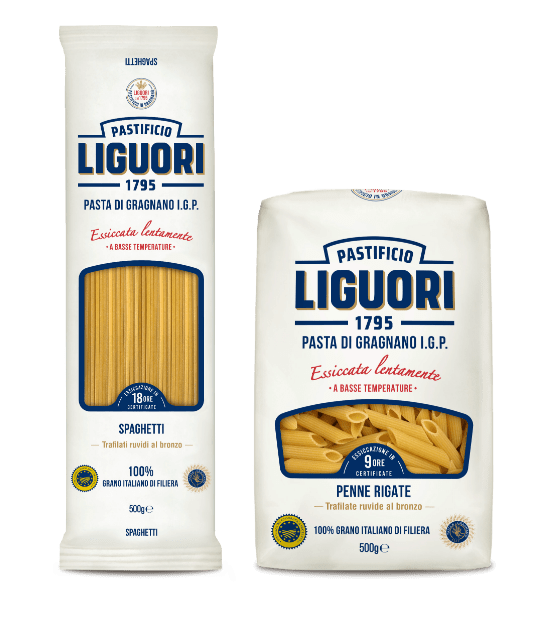
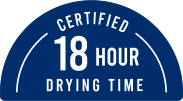
We dry short pasta for 9 hours certified and long pasta for 18 hours certified.
Drying is the most delicate stage of the process, since the chemical-physical and organoleptic characteristics of the finished product, such as colour, flavour and cooking strength, depend on its progress.
Drying consists in the extraction of water, pasta being a dry product.
This extraction must be carried out in a gradual and controlled manner in order to obtain a finished product with the following features:

The drying process takes place in continuous production lines, using drying tunnels.
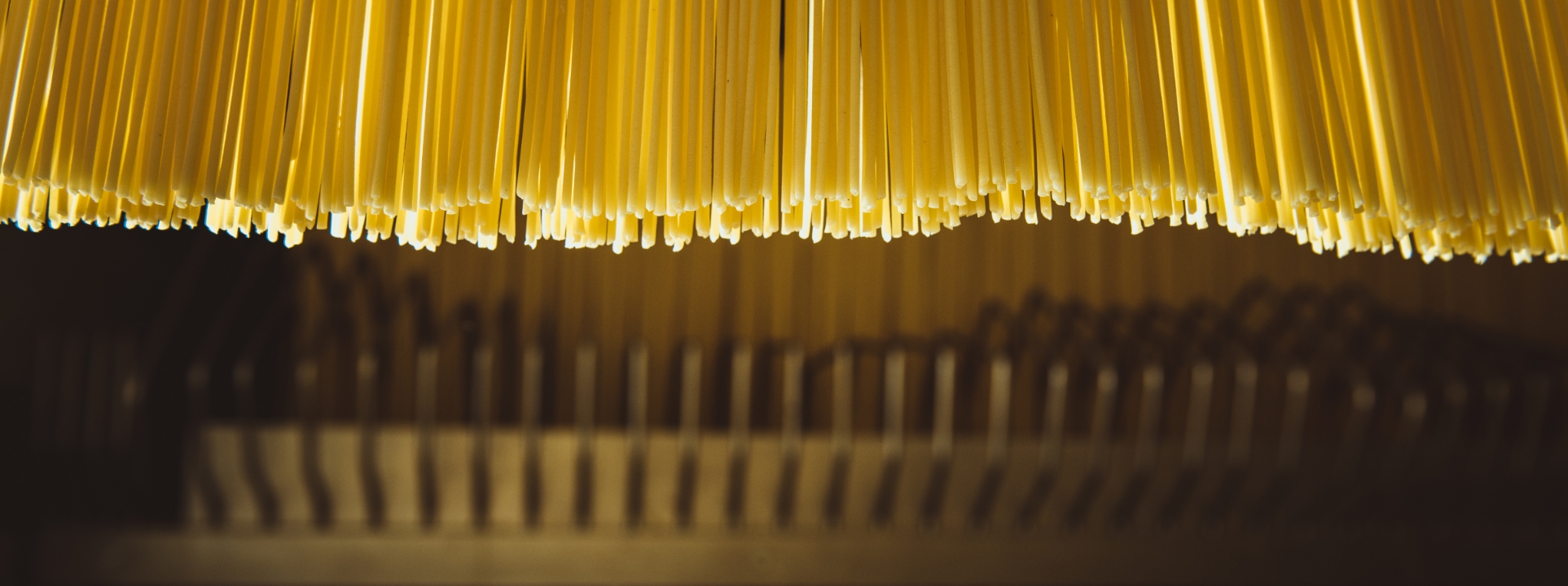
After being spread on special rods, the long pasta is dried by moving them forward inside the drying tunnel, with a sinusoidal downward movement.
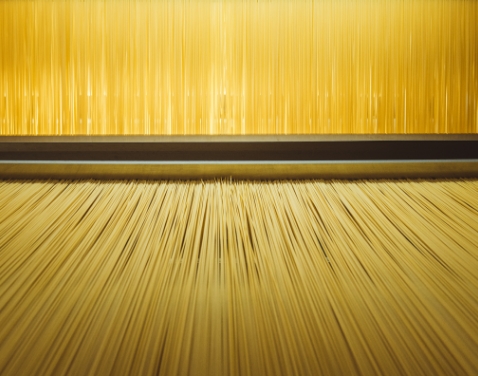
The short pasta is instead distributed on conveyor belts and moved forward inside the drying tunnels, also in this case with a sinusoidal downward movement.
For Pastificio Liguori, respecting the company's know-how made it necessary to structure a slow, low-temperature drying technological process with specially designed and constructed drying lines.
What makes the difference, however, is the very high degree of specialisation of our operators.
In fact, the drying phase takes place according to special “recipes”, designed for each individual format, so as to guarantee that the layer of pasta inside the drying tunnels is traversed, at the right times, by air currents and exposed to the winds, thus favouring heat and steam exchange on every side of the product.
The increase in the exchange surface and the product's resting time make the use of mild technology possible, as there are spaces and surfaces that do not employ strong temperatures for the drying process.
The low temperatures used are aimed at safeguarding the chemical, physical and nutritional values of the finished product.
In fact, at the end of the process, it is possible to highlight how the chemical-physical and nutritional parameters found in the raw material overlap with those of the finished product.
Slow drying preserves the integrity of the proteins and enhances the hold during cooking. It also avoids chemical reactions found at higher temperatures that generate unnatural compounds that give the pasta an intense yellow colour, sometimes tending towards orange.

In addition to guaranteeing a product with special characteristics, slow drying at low temperatures is also aimed at the pursuit of excellence. In fact, slow drying at low temperatures confirms the company's decision to prefer quality over quantity, thus protecting our consumers and our tradition.